FLARE Architecture
Purpose and Scope
This document describes NVIDIA FLARE’s overall system architecture, including its major subsystems, process model, and component interactions. It provides a technical overview of how the platform orchestrates federated learning workloads across distributed participants.
For detailed information about specific subsystems:
Communication infrastructure: see CellNet Architecture
Provisioning and deployment: see Provisioning in NVIDIA FLARE
Security: see NVIDIA FLARE Security Overview
Architectural Overview
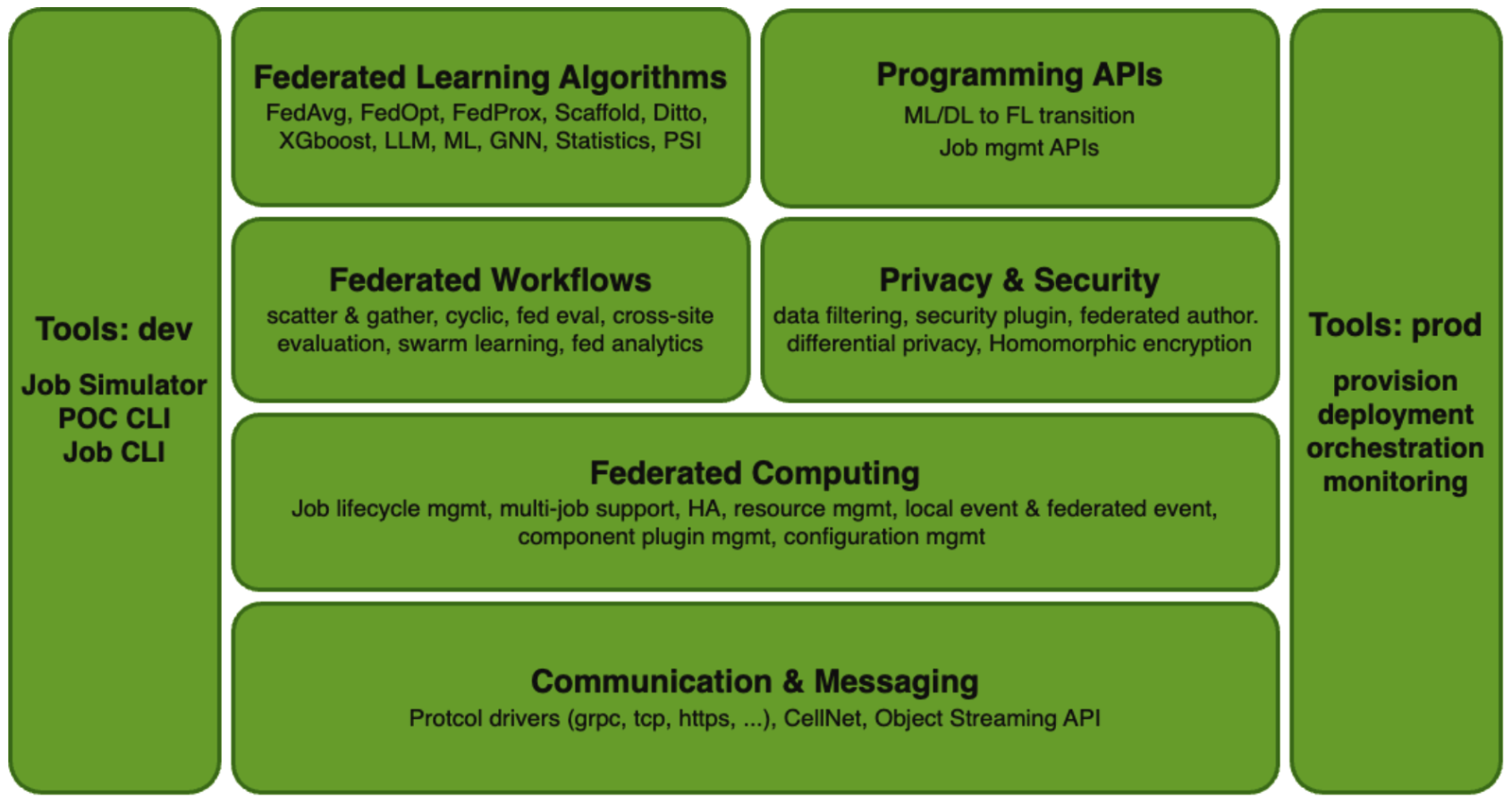
NVIDIA FLARE is a distributed federated learning platform with a multi-process, component-based architecture. The system is organized into distinct layers: user interaction, provisioning, runtime execution, communication, and storage.
The FLARE architecture comprises three main layers:
Foundation Layer: Communication infrastructure, messaging protocols, privacy preservation tools, and secure platform management.
Application Layer: Building blocks for federated learning, including federation workflows and learning algorithms.
Tooling: FL Simulator and POC CLI for experimentation and simulation, plus deployment and management tools for production workflows.
Core Design Principles
Component-Based Design
The architecture uses pluggable components (Controller, Executor, Filter, Aggregator) defined in
JSON configuration files to implement federated learning algorithms. This enables flexible composition of
workflows without code changes.
Multi-Process Isolation
Parent processes (ProcessType.SERVER_PARENT, ProcessType.CLIENT_PARENT) manage system lifecycle and spawn
isolated job processes (ProcessType.SERVER_JOB, ProcessType.CLIENT_JOB) for workload execution. This
provides fault tolerance and resource isolation.
Cell-Based Communication
All inter-process and inter-machine communication uses the Cell class from the F3 CellNet framework. Addressing
uses Fully Qualified Cell Names (FQCN), and messages are routed through predefined CellChannel values.
Multiple Deployment Modes
The same core classes support three deployment modes: SimulatorRunner (single process with threads), POC mode
(multiple processes on localhost), and production (distributed processes with mTLS).
Core Components
Primary System Modules
Component |
Primary Classes/Modules |
Purpose |
|---|---|---|
FL Runtime |
ServerEngine, ClientEngine, JobRunner |
Core federated learning orchestration and execution |
Job Management |
Job definition, storage, scheduling |
Job lifecycle and state management |
Communication |
Cell, CoreCell, StreamCell, Pipe |
Secure inter-party communication with streaming support |
Client Integration |
ClientAPI (flare.receive(), flare.send()), LauncherExecutor |
ML framework integration and external process management |
Administration |
Dashboard, Admin Console |
Programmatic and GUI-based system management |
Deployment |
ProvisionerSpec, WorkspaceBuilder |
Certificate generation, configuration, and secure deployment |
Workflows |
ScatterAndGather, FedAvg, ModelController |
Built-in federated learning algorithms and patterns |
Multi-Process Architecture
NVIDIA FLARE uses a multi-process architecture where parent processes manage system lifecycle and spawn isolated job processes for workload execution.
Process Types
Process |
Code Symbol |
Description |
|---|---|---|
SP |
|
Server parent process running FederatedServer and ServerEngine |
SJ |
|
Server job process running ServerRunner and workflow Controllers |
CP |
|
Client parent process running FederatedClient and ClientEngine |
CJ |
|
Client job process running ClientRunner and Executors |
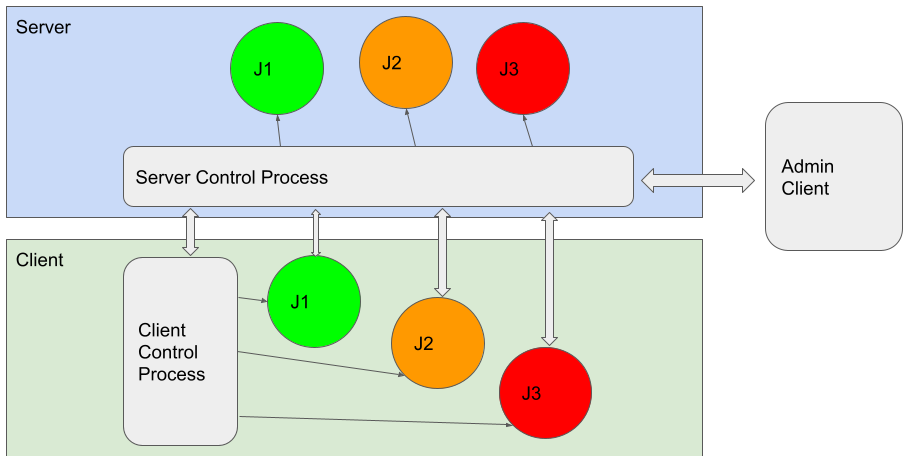
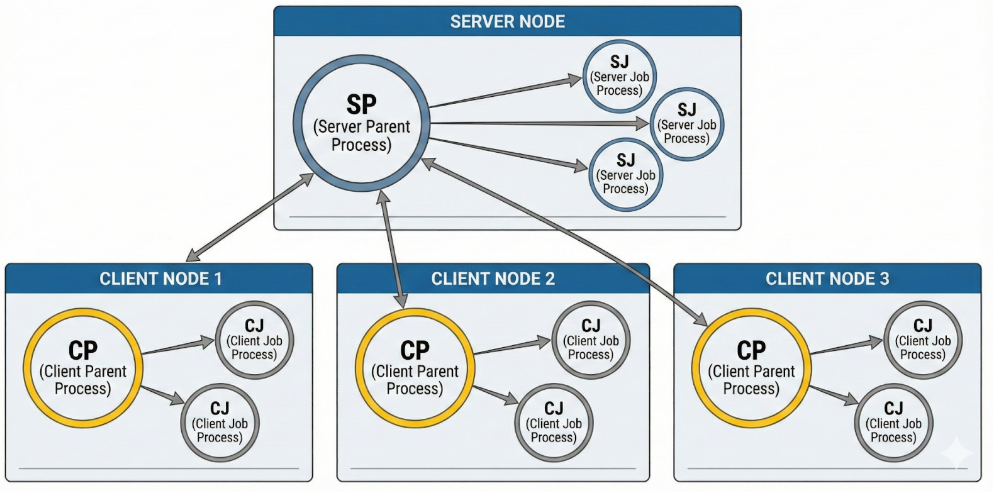
Process Responsibilities
Server Parent (SP)
Runs
FederatedServerfor client registration and heartbeat monitoringHouses
ServerEnginewhich orchestrates job scheduling viaJobRunnerSpawns Server Job (SJ) processes or containers for each active job
Manages authentication and token issuance for clients
Server Job (SJ)
Runs
ServerRunnerfor workflow executionExecutes workflow Controllers (e.g.,
ScatterAndGather,FedAvg)Broadcasts tasks to client jobs and aggregates results
Isolated process per job for fault tolerance
Client Parent (CP)
Runs
FederatedClientfor registration with serverHouses
ClientEnginewhich coordinates job executionSpawns Client Job (CJ) processes or containers for assigned jobs
Maintains connection heartbeat with server
Client Job (CJ)
Runs
ClientRunnerfor task executionPulls tasks from server via Cell network
Launches training processes using
LauncherExecutorRoutes task data to/from training process via Pipe
Training Process
User’s ML training script
Uses Client API:
flare.init(),flare.receive(),flare.send()Communicates with CJ via FilePipe (file-based) or CellPipe (network-based)
Process Lifecycle and Spawning
Job processes are spawned dynamically when jobs are scheduled:
Job Submission: Admin submits job via
nvflare job submitScheduling:
JobRunnerselects job based on policy and resource availabilityServer Job Spawn: SP spawns SJ process with job configuration
Client Notification: SP notifies registered clients to start job
Client Job Spawn: Each CP spawns CJ process for the job
Execution: SJ and CJ processes execute workflow
Completion: Processes terminate and report status to parents
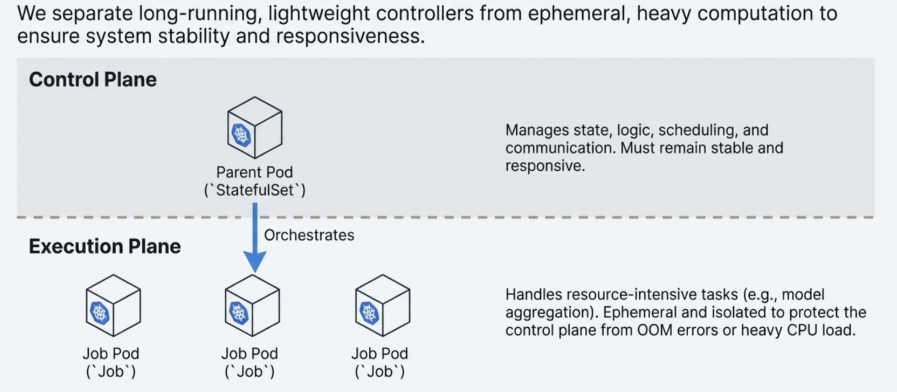
K8s-native Architecture: Control and Execution Planes Separation
Note
K8s-native deployment support was introduced in FLARE 2.8.0. For deployment steps, Helm chart generation, parent pods, and dynamically launched job pods, see Running FLARE in Kubernetes.
Parent pods manage the system lifecycle and spawn job pods (server job pod, client job pod) for workload execution. The server hosts the central coordination logic and is designed to be resilient, scalable, and capable of handling high-throughput metadata traffic separately from high-volume data traffic. The following diagram illustrates the Server Parent (SP), Server Job (SJ), and related pods within the Kubernetes environment.
Communication Framework
The Communication Framework, also known as F3 (FLARE Foundation Framework) and CellNet, provides the foundational messaging infrastructure for all communication in NVIDIA FLARE.
Key capabilities include:
FQCN Addressing: Hierarchical cell names (e.g.,
server.job_123,client.site-1.job_123)Channel-Based Routing: Predefined channels for task distribution, commands, and auxiliary messages
Secure Messaging: End-to-end encryption with certificate-based authentication
Large Data Streaming: Automatic chunking with flow control for model weights and datasets
CellNet uses a three-layer architecture (CoreCell → StreamCell → Cell) that abstracts transport details and supports multiple protocols (gRPC, TCP, HTTP).
For detailed information on CellNet internals, channels, streaming components, and communication patterns, see CellNet Architecture.
Message Flow: Task Pull Pattern
FLARE uses a pull-based task distribution pattern:
Task Creation: Controller creates task with payload
Task Broadcast: ServerRunner broadcasts task availability
Task Pull: ClientRunner pulls task via
CellChannel.SERVER_MAINTask Execution: Executor processes task, produces result
Result Push: ClientRunner sends result via
CellChannel.SERVER_MAINResult Processing: Controller aggregates results
Client API Job Process
The Client API provides a simplified interface for integrating user training scripts with the FLARE job process. With just a few lines of code changes, data scientists can convert centralized training code to federated learning.
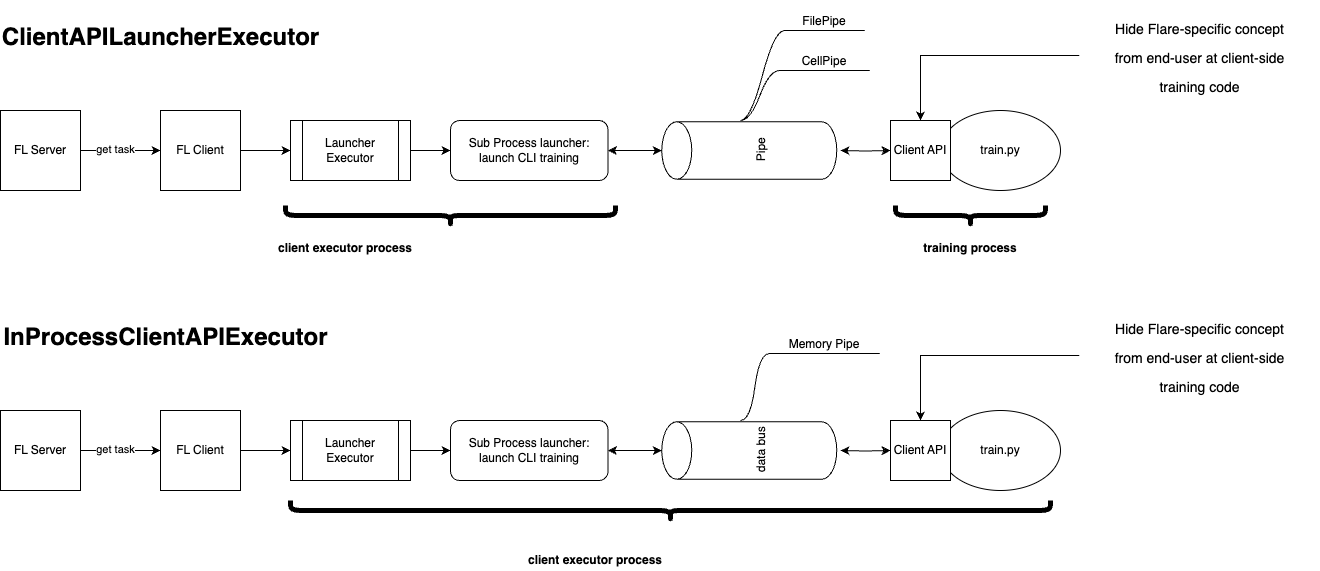
Key characteristics:
Minimal Code Changes: Three core methods (
init(),receive(),send()) handle all FL communicationTwo Execution Modes: In-process (single GPU, maximum performance) or sub-process (multi-GPU, process isolation)
Framework Support: Works with PyTorch, PyTorch Lightning, HuggingFace, and other frameworks
For detailed Client API documentation, communication patterns, configuration options, and examples, see Client API
Job Management
Job Structure
A FLARE job consists of:
meta.json: Job metadata (name, deploy map, resource requirements)
config_fed_server.json: Server-side component configuration
config_fed_client.json: Client-side component configuration
Custom code: Application-specific components and scripts
Job Lifecycle States
State |
Description |
|---|---|
|
Job submitted, awaiting scheduling |
|
Job assigned to clients, processes starting |
|
Job actively executing |
|
Job completed successfully |
|
Job aborted by admin request or by a failure classified as an abort |
|
Job failed due to an execution exception, such as a launcher startup
failure or a Kubernetes job pod stuck in |
JobRunner Architecture
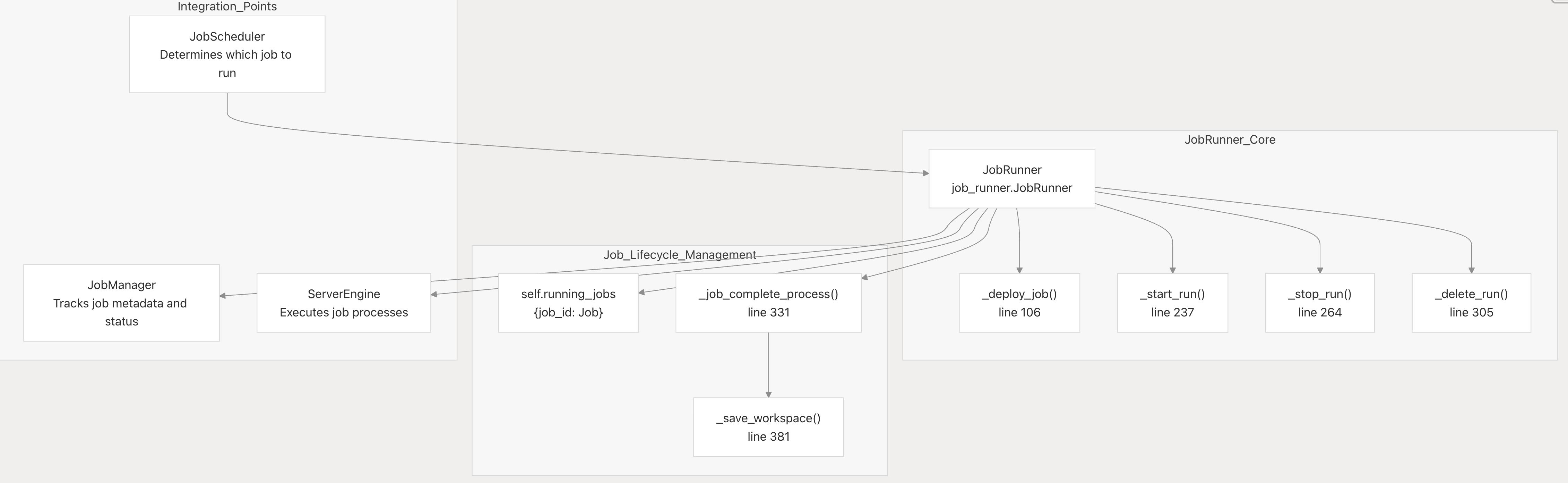
The JobRunner is responsible for:
Monitoring submitted jobs in the job store
Scheduling jobs based on policy and resource availability
Deploying jobs to server and client processes
Tracking job status and handling completion/failure
Deployment Modes
NVIDIA FLARE provides three deployment modes that share the same core runtime but differ in packaging, security, and deployment complexity.
Deployment Modes Comparison
Mode |
Use Case |
Security |
Processes |
Setup Time |
|---|---|---|---|---|
Simulator |
Rapid prototyping, algorithm testing |
None |
Single process with threads (may spawn multiple processes in some cases) |
Seconds |
POC |
Local multi-client testing, workflow validation |
Optional |
Multiple processes on localhost |
Minutes |
Production |
Real-world distributed deployment |
Full PKI/mTLS |
Distributed across machines |
< 1 hr (with provisioning) |
Simulator Mode
Simulator mode runs the entire FL system in a localhost using threads and processes
Characteristics:
Single process with
SimulatorRunnerClients simulated as threads sharing memory
Uses network communication (in-memory message passing coming soon)
Fastest iteration for algorithm development
Usage with Job Recipe:
recipe = FedAvgRecipe(...)
env = SimEnv(num_clients=n_clients, num_threads=n_clients)
recipe.execute(env=env)
Usage with CLI:
nvflare simulator -w workspace -n 2 -t 2 <job_dir>
POC Mode
POC mode launches separate processes for server and clients on localhost.
Characteristics:
Server parent process with separate client parent processes
Uses actual network communication (gRPC on localhost)
Job processes spawn using same mechanism as production
TLS optional (for testing purposes)
Usage with Job Recipe:
recipe = FedAvgRecipe(...)
env = POCEnv(num_clients=2)
recipe.execute(env=env)
Usage with CLI:
nvflare poc prepare -n 2
nvflare poc start
nvflare job submit -j <job_dir>
Production Mode
Production mode deploys across multiple machines with full security enforcement.
Requirements:
Separate machines for server and clients
PKI certificates generated by Provisioner
All certificates signed by root CA
Optional: Relay nodes for hierarchical connectivity
Characteristics:
Server runs via
nvflare.private.fed.app.server.server_trainClients run via
nvflare.private.fed.app.client.client_trainAll Cell instances use mTLS (mutual TLS)
Full authentication and authorization enforcement
Security Architecture
PKI and Certificate Management
NVIDIA FLARE uses PKI for mutual authentication in secure mode:
Certificate Hierarchy:
Root CA: Self-signed certificate authority generated during provisioning
Server Certificate: Signed by Root CA, identifies server
Client Certificates: Signed by Root CA, unique per client
Admin Certificates: Signed by Root CA, include role attributes for RBAC
Authentication Protocol:
Client sends challenge (random nonce) to server
Server proves identity by signing nonce with its private key
Client validates server, sends registration with signed response
Server issues authentication token for subsequent requests
Token-Based Authentication:
After registration, all messages include authentication headers:
TOKEN: Client authentication tokenTOKEN_SIGNATURE: Server signature for verificationSSID: Service session ID
Configuration and Customization
Component Configuration
FLARE uses JSON configuration files to assemble components:
Server Configuration (config_fed_server.json):
{
  "format_version": 2,
  "workflows": [
    {
      "id": "scatter_and_gather",
      "path": "nvflare.app_common.workflows.scatter_and_gather.ScatterAndGather",
      "args": {"min_clients": 2, "num_rounds": 3}
    }
  ],
  "components": [
    {"id": "persistor", "path": "..."},
    {"id": "aggregator", "path": "..."}
  ]
}
Client Configuration (config_fed_client.json):
{
  "format_version": 2,
  "executors": [
    {
      "tasks": ["train", "validate"],
      "executor": {"path": "...", "args": {...}}
    }
  ]
}
Filter Pipeline
Filters implement privacy preservation and data transformation:
Task Data Filters: Applied before executor receives task
Task Result Filters: Applied after executor produces result
Direction:
IN(server→client) orOUT(client→server)
Common Filters:
PercentilePrivacy: Clip values to percentilesDifferentialPrivacyFilter: Add noise for differential privacyExcludeVars: Exclude specific variables from sharing
Additional Resources
CellNet Architecture: CellNet Architecture
Security Overview: NVIDIA FLARE Security Overview
Provisioning: Provisioning in NVIDIA FLARE
Job Recipe API: NVFlare Job Recipe
FLARE CLI: NVFlare CLI