CellNet Architecture
Purpose and Scope
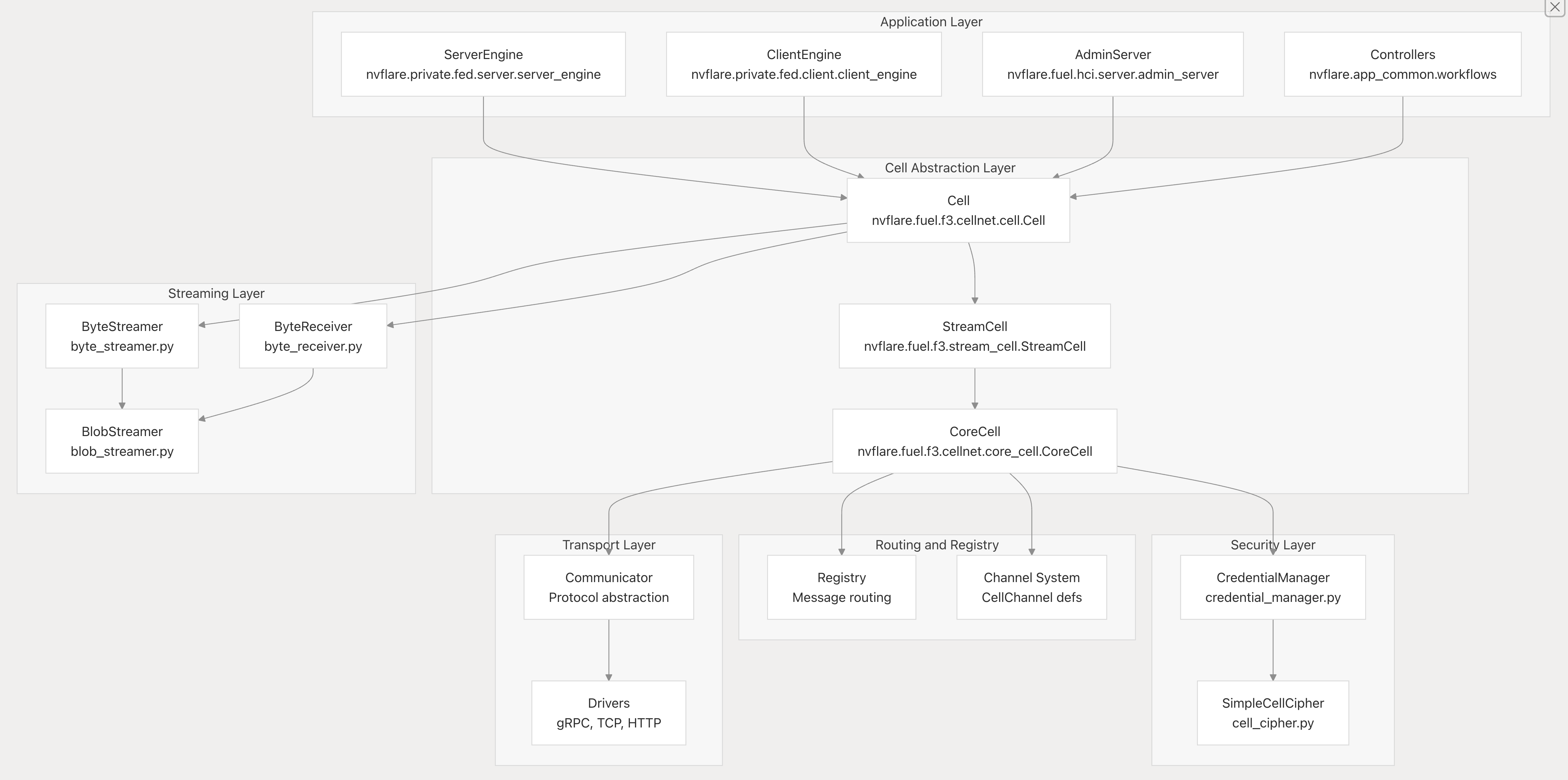
CellNet is FLARE’s unified communication layer that provides secure, scalable messaging between distributed federated learning components. It abstracts away network transport details and provides a consistent API for both small messages and large data transfers.
Position in NVFLARE Architecture: CellNet sits between the application layer (Controllers, Executors, Admin commands) and the network transport layer (gRPC, TCP, HTTP drivers). All NVFLARE components communicate through CellNet, including:
Server-to-client task distribution
Client-to-server result submission
Peer-to-peer communication
Admin command execution
Cross-site auxiliary communication
Job deployment and management
Key Design Goals
Unified API: Single interface for both small messages and large data streams
Transport Agnostic: Supports multiple network protocols (gRPC, TCP, HTTP)
Hierarchical Addressing: FQCN-based routing for multi-level cell hierarchies
Secure Communication: Built-in encryption and authentication
Flow Control: Automatic chunking and flow control for large transfers
Three-Layer Architecture
CoreCell: Basic message routing, connection management, security
StreamCell: Large data streaming with chunking and flow control
Cell: High-level request/reply patterns with automatic channel detection
Layered Cell Architecture
Three-Layer Design
The CellNet architecture consists of three layers, each extending the previous:
Layer 1: CoreCell - Basic Message Infrastructure
CoreCell provides the fundamental messaging infrastructure:
Key Responsibilities:
Message Handling - Routes messages to appropriate handlers based on channel/topic
Connection Management - Manages listeners (incoming) and connectors (outgoing)
Callback Registry - Stores message handlers in
req_reg: RegistryAgent Tracking - Maintains
agents: Dict[str, CellAgent]for remote cellsRequest Tracking - Tracks pending requests in
waiters: Dict[str, _Waiter]Security - Delegates to
credential_manager: CredentialManagerfor encryption
Core Methods:
send_request (channel, target, topic, request, timeout, …) - Send message and wait for reply
fire_and_forget (channel, topic, targets, message, …) - Send without waiting
broadcast_request (channel, topic, targets, request, …) - Send to multiple targets
register_request_cb (channel, topic, cb, …) - Register callback for channel/topic
Layer 2: StreamCell - Large Data Transfer
The StreamCell adds large data transfer capabilities on top of CoreCell:
Key Components:
cell: CoreCell - Wrapped CoreCell for basic messaging
byte_streamer: ByteStreamer - Sends data as chunked streams
byte_receiver: ByteReceiver - Receives and reassembles chunks
blob_streamer: BlobStreamer - Optimized for in-memory BLOBs
Streaming Methods:
send_stream (channel, topic, target, message, …) - Send byte stream with flow control
send_blob (channel, topic, target, message, …) - Send BLOB (fits in memory)
register_stream_cb (channel, topic, stream_cb, …) - Register stream receiver
register_blob_cb (channel, topic, blob_cb, …) - Register BLOB receiver
Streaming Protocol:
Automatic chunking into configurable chunk sizes (default 1MB)
Flow control with sliding window and ACKs
Progress tracking via StreamFuture
Layer 3: Cell - Intelligent Request/Reply
The Cell class provides a unified interface for streaming and non-streaming messages:
Key Features:
Dynamic Method Dispatch:
Intercepts method calls and checks if the channel requires streaming via
_is_stream_channel()Routes to the appropriate implementation:
Stream channels →
_broadcast_request(),_send_request(), etc.Non-stream channels →
core_cell.broadcast_request(), etc.
Channel Classification:
Excluded Channels (non-streaming):
CellChannel.CLIENT_MAIN- Admin commandsCellChannel.SERVER_MAIN- Task distributionCellChannel.RETURN_ONLY- Internal repliesCellChannel.CLIENT_COMMAND- Client commandsOther internal channels
Request Tracking:
Maintains
requests_dict: Dict[str, SimpleWaiter]for pending requestsSimpleWaitertracks request state and receiving progressReply handling via
_process_reply()
Callback Adaptation:
Adapterclass wraps application callbacks for streamingHandles encoding/decoding of stream payloads
Sends replies back via
RETURN_ONLYchannel
FQCN: Fully Qualified Cell Name:
Every cell is identified by a Fully Qualified Cell Name (FQCN), which is a dot-separated hierarchical name:
<site_name>[.<job_id>[.<rank>]]
End-to-end Encryption: All messages can be encrypted for secure communication.
Message Structure and Addressing
Channel and Topic Addressing
F3 CellNet routes messages using a two-level addressing scheme: channel and topic. This is stored in message headers:
Constant |
Value |
Purpose |
|---|---|---|
CellChannel.CLIENT_MAIN |
“admin” |
Admin commands |
CellChannel.SERVER_MAIN |
“task” |
Task distribution |
CellChannel.AUX_COMMUNICATION |
“aux_communication” |
Application-defined |
CellChannel.RETURN_ONLY |
“return_only” |
Internal reply routing |
CellChannel.SERVER_COMMAND |
“server_command” |
Server commands |
Communication Patterns
Request-Reply Pattern – send request and wait for reply
Fire-and-Forget Pattern – send message without waiting for reply
Broadcast Pattern – send to multiple targets
Streaming Components Overview
The streaming system is organized into sender components, receiver components, and stream abstractions:
Key Streaming Classes:
Class |
Purpose |
|---|---|
ByteStreamer |
Sends byte streams as chunks |
ByteReceiver |
Receives and reassembles chunks |
BlobStreamer |
Wraps blobs for streaming |
TxTask |
Per-stream sending task |
RxTask |
Per-stream receiving task |
Performance and Statistics
CellNet includes comprehensive statistics collection for monitoring and debugging.
Statistics are collected via StatsPoolManager with categories for different operation types and cell FQCNs.