Message Quantization
Message quantization in NVIDIA FLARE reduces communication overhead in federated learning by reducing the precision of transmitted updates. This feature is particularly beneficial for large language models (LLMs) where the default fp32 message precision can artificially inflate message size.
Background
Previous NVFlare default transmission mode was float32 numpy, which could lead to unnecessarily large messages when working with reduced precision models (e.g., bf16). This was due to the conversion process (bf16->float32) and size doubling. For LLMs, federated aggregation may not be sensitive to quantization, making full precision communication unnecessary.
Two key features were added to improve NVFlare’s messaging efficiency for LLMs:
Direct tensor communication without converting to numpy - Enables sending tensors directly without numpy conversion - Preserves special data formats like bf16 that aren’t supported by numpy - Eliminates the need to cast to float32 before numpy conversion
Model quantization and dequantization filters - Quantizes messages before transmission - Dequantizes after transmission in both directions - Reduces transmission size while maintaining original precision for computations
Implementation
Message quantization is implemented using a filter mechanism that handles the quantization and dequantization of model updates. The process involves:
Quantization of model updates before transmission
Transmission of the quantized data
Dequantization of the received data
Training and aggregation at original precision
We utilize bitsandbytes for 8- and 4-bit quantization functionality. The quantization filter automatically recognizes message format (numpy or tensor) and processes accordingly.
For a practical implementation example, see the LLM example which demonstrates message quantization in a real-world scenario.
Key Features
Quantization and dequantization implemented with filter mechanism
No code changes required from user side - same training script works with/without quantization
Training and aggregation performed at original precision to minimize impact on training process
Support for both numpy arrays and torch Tensors
Direct cropping and casting for fp32 to fp16 conversion
8- and 4-bit quantization using bitsandbytes
Precision Options and Performance
The following precision options are available, with their respective size reductions:
32-bit (fp32): Original precision, no quantization
16-bit (fp16, bf16): 50% size reduction
8-bit: 75% size reduction
4-bit (fp4, nf4): 86% size reduction
Precision |
Model Size (MB) |
Quantization Meta Size (MB) |
fp32 Size Percentage |
|---|---|---|---|
32-bit (fp32) |
5716.26 |
0.00 |
100.00% |
16-bit (fp16, bf16) |
2858.13 |
0.00 |
50.00% |
8-bit |
1429.06 |
1.54 |
25.03% |
4-bit (fp4, nf4) |
714.53 |
89.33 |
14.06% |
Performance Impact
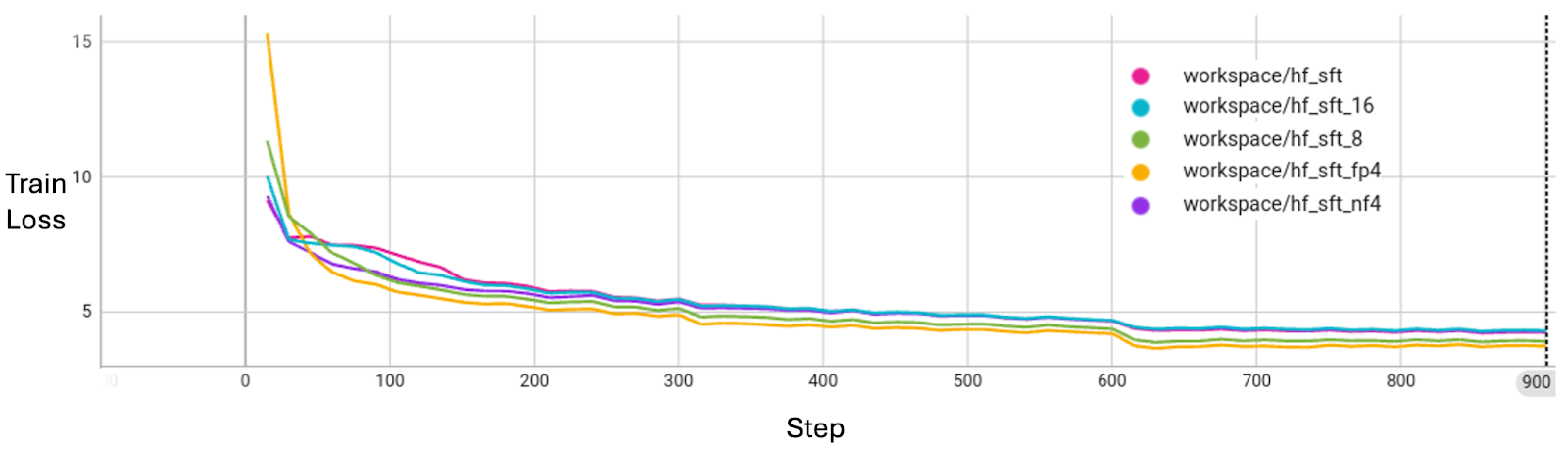
Message quantization does not sacrifice model convergence quality. As shown in the experiments with LLM Supervised Fine-Tuning (SFT), the training loss curves align well across different precision levels.
Summary
Message quantization provides:
Significant bandwidth savings
No impact on model convergence
Support for various precision levels
Seamless integration with existing training scripts
Compatibility with both numpy and PyTorch